
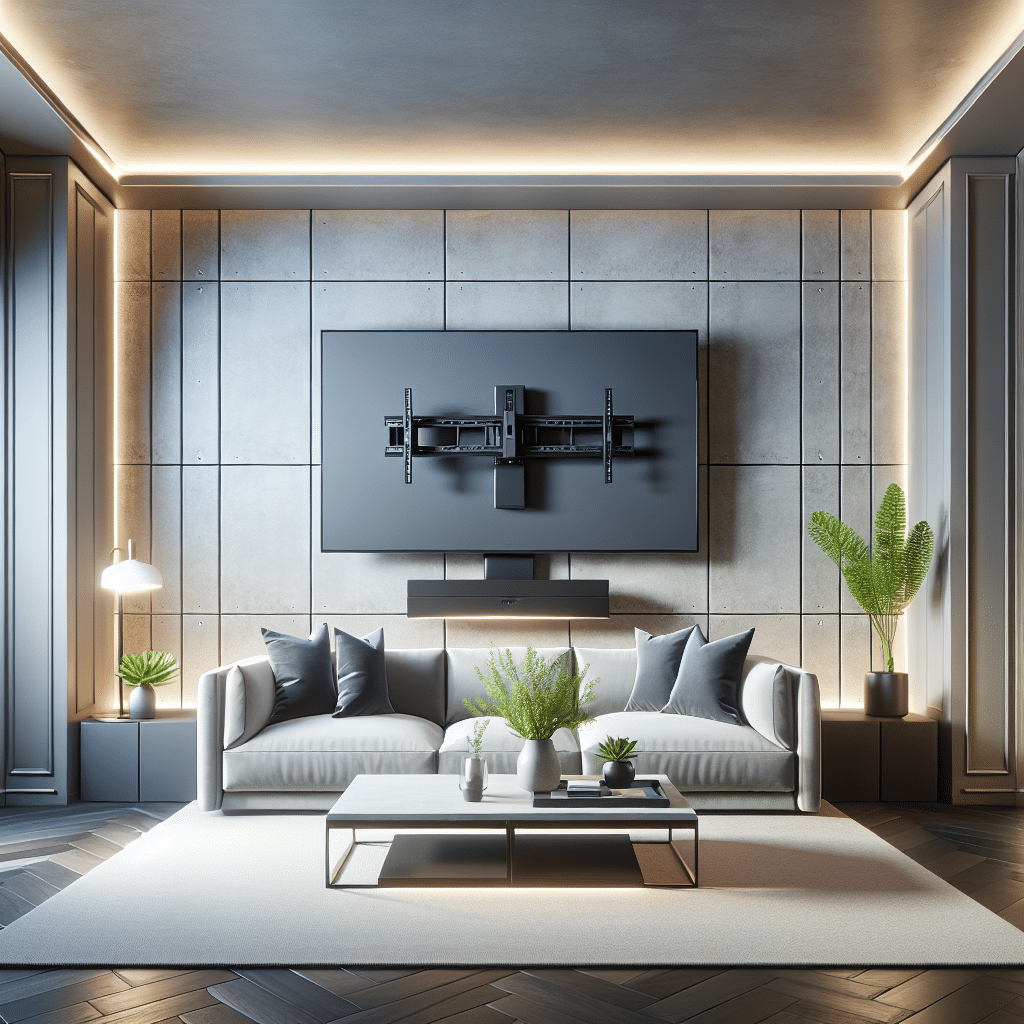
A motorized mount makes sense when the television needs to move to a repeatable viewing position. That could mean lowering a screen from above a mantel, swiveling a large display toward another part of the room, or retracting a television when it is not in use. It is not automatically the best mount for a high-end room. Motors add weight, wiring, moving clearances, and another component that may eventually need service.
Define the motion you actually need
Motorized mounts are often grouped together even though they solve different problems: drop-down fireplace mounts, horizontal swivel mounts, ceiling lifts, and cabinet lifts. Measure the required vertical travel, swivel angle, wall clearance, and final screen position. If a manual full-motion arm reaches the same usable position, it may be simpler and quieter.
Compatibility is more than screen size
Check the television's actual weight, VESA hole pattern, cabinet dimensions, connection locations, and mount clearance. VESA defines the mounting interface, but every motorized model also has its own load and geometry limits.[1] Peerless-AV recommends considering the combined display and mount weight when evaluating the supporting structure.[2]
Read the specifications literally
As one real-world example, MantelMount publishes a 20 to 115 pound capacity, 26 inches of vertical drop, 30 degrees of swivel in either direction, and VESA support from 200 x 200 through 600 x 600 for its MM815.[3] Those numbers describe that product, not motorized mounts as a category. A television can fit the advertised screen-size range and still miss the mount's weight, VESA, depth, or clearance limits.
Fireplace installations need a heat decision first
A motorized drop-down mount can improve the viewing angle, but it does not protect the television from excessive heat. Samsung says it does not recommend mounting its TVs above a fireplace and states that its televisions should never exceed 104°F.[4] Check the exact television manual, fireplace clearances, mantel, and wall temperature during normal use.
Plan power, control, and cable movement
- Confirm whether the motor requires a nearby receptacle or low-voltage power supply.
- Check what happens after a power outage.
- Find out whether control is by remote, app, contact closure, voice platform, or more than one method.
- Leave enough cable slack for every position without pinching or rubbing.
- Make sure the TV inputs, motor, and control box remain serviceable.
- Check noise, travel speed, presets, stop behavior, and warranty terms.
Who should choose one
A motorized mount is useful when it solves a measured placement problem or supports accessibility. It is a poor fit when the wall structure is uncertain, the screen can be placed comfortably without motion, or the owner does not want to maintain a powered mechanism. Buy the movement you need, not the fanciest product category.
Sources
Manufacturer requirements and standards can change. Check the documentation for your exact television, mount, wall system, and room before installation.
- VESA Flat Display Mounting Interface Standard (accessed September 21, 2026)
- Peerless-AV mount buying guide (accessed September 21, 2026)
- MantelMount MM815 published specifications (accessed September 21, 2026)
- Samsung wall-mounting considerations (accessed September 21, 2026)